Modern software development is no longer defined by frameworks, languages, or headcount. It is defined by orchestration: how humans, AI agents, tools, and context interact inside a single, coherent system.
The Day10 Agent Orchestration System is our internal execution layer - a unified control plane that coordinates senior engineers, AI agents, and best-in-class tools across the entire software development lifecycle (SDLC).
This system is the reason small Day10 pods consistently deliver what once required much larger teams.

Best-in-class tools, wired into a single execution layer. Very few teams operate inside an AI-native system.
Day10’s orchestration layer unifies:
01
Human decision-makers (product, engineering, architecture)
02
AI agents (planning, generation, validation, review)
03
Specialized tools (coding, design, infra, testing, evals)
04
Persistent project context:
Requirements → Architecture → Code → Tests → Deployment
Instead of fragmented usage across IDEs, docs, and dashboards, everything is wired through a single orchestration flow.
What this enables
01
End-to-end context preservation
(powered by HumanLayer)
→
Requirements
→
Architectural decisions
→
Domain constraints
→
Historical tradeoffs stay accessible to both humans and agents at every step
02
Deterministic workflows for probabilistic systems
(Claude Code + internal orchestration & evaluation stack)
→
AI output is constrained, validated, reviewed, and traced - not blindly accepted.
03
Parallel execution without context loss
(Claude Code + internal MCP/A2A-based coordination)
→
Multiple agents work simultaneously while remaining aligned to the same source of truth.
The AI tooling ecosystem evolves weekly. Any system that hard-codes a single tool is obsolete by default.
We reinvest half of our profits into internal R&D, focused on:
01
Evaluating emerging AI tools for coding, design, testing, deployment, and reasoning
02
Stress-testing them against real production workloads
03
Integrating only those that meet our standards for reliability, speed, and controllability
Cursor was state-of-the-art until it wasn’t. Claude Code now outperforms it for many classes of work. That will change again — and we’re prepared for it.
Off-the-shelf tools are phenomenal but still insufficient. The real gains come from custom agents that understand:
Your codebase
Your architecture
Your domain
Your delivery constraints
Proprietary agents
Examples
01
Architecture Guardian Agent.
Continuously evaluates AI-generated and human-written code against:
→
Architectural boundaries
→
Dependency rules
→
Performance constraints
→
Security and compliance requirements
→
Flags violations before they reach production
02
Test Generation & Coverage Agent
→
Generates, updates, and validates unit, integration, and system tests based on actual code behavior.
03
Cost & Latency Optimization Agent
→
Monitors model usage, token spend, latency, and throughput. Recommends architectural or model-level optimizations in real time.
Accelerators
[01]
RAG pipelines
for common enterprise data shapes
[02]
Deployment templates
for AI-heavy workloads
[03]
Evaluation harnesses
for model output quality and drift
Stack expertise matters less. System fluency matters more. We believe deep specialization in a single framework or programming language is becoming less important over time. What matters now is engineering judgment and system-level thinking. That said, our teams are fluent across the stacks most companies rely on today:
Backend




Frontend



Mobile



Cloud & Infrastructure


AI changes how software is built - not the reality that these ecosystems still exist
We bridge both worlds without legacy drag
For complex AI-native systems, shallow tooling breaks quickly. We operate deep in the modern AI stack, including:
Core AI & ML
01
PyTorch
02
TensorFlow
03
SciPy
04
Custom model fine-tuning and evaluation pipelines
Agent & Orchestration Frameworks
01
LangChain
02
LangGraph
03
Deep Agents
04
Custom multi-agent planning and validation loops
Data, Retrieval & Reasoning
01
Vector databases
02
Advanced RAG architectures
03
Tool-calling with guardrails
04
Structured reasoning chains and decision graphs
Monitoring & Evaluation
01
Output quality evaluation
02
Drift detection
03
Hallucination tracking
04
Latency and cost observability
/Agent Orchestration System
Smaller teams. Higher throughput. Compounding velocity.
The outcome of this system is not theoretical:
Productivity with senior pods
Handoffs, meetings, less waste
Iteration without sacrificing quality
Systems that improve as AI improves - instead of being rewritten
This is how modern software is built now. And it’s the foundation
everything at Day10 runs on.

Boris Cherny
Anthropic
The Day10 Orchestration Layer

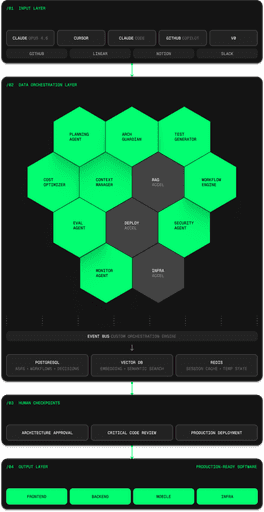
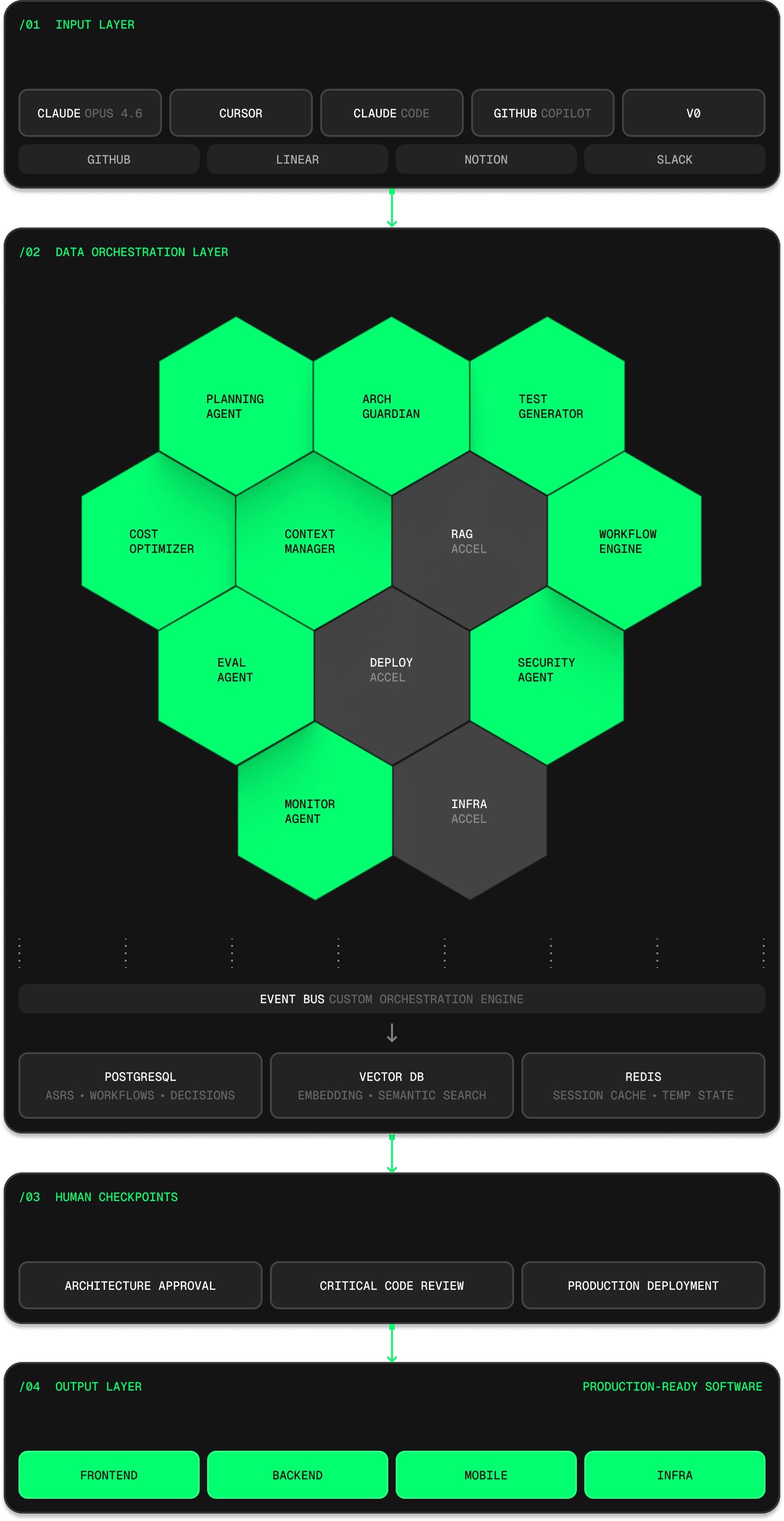
Proprietary Agents
01
Planning Agent
Breaks features into tasks
02
Architecture Guardian
Validates architectural decisions
03
Test Generator
Creates test suites
04
Cost Optimizer
Maintains project context across SDLC
05
Context Manager
Maintains project context across SDLC
06
Workflow Engine
Orchestrates agent execution & quality gates
07
Evaluation Agent
Scores outputs, resolves conflicts
08
Security Agent
Scans for vulnerabilities & compliance
09
Monitor Agent
Tracks system health & performance
Accelerators
01
RAG Accelerator
Pre-built RAG pipeline templates
02
Deploy Accelerator
Terraform configs + CI/CD templates
03
Infra Accelerator
Cloud infrastructure templates
04
Not agents
They're libraries/templates that agents USE
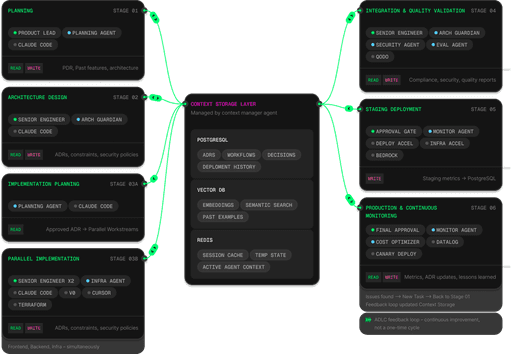
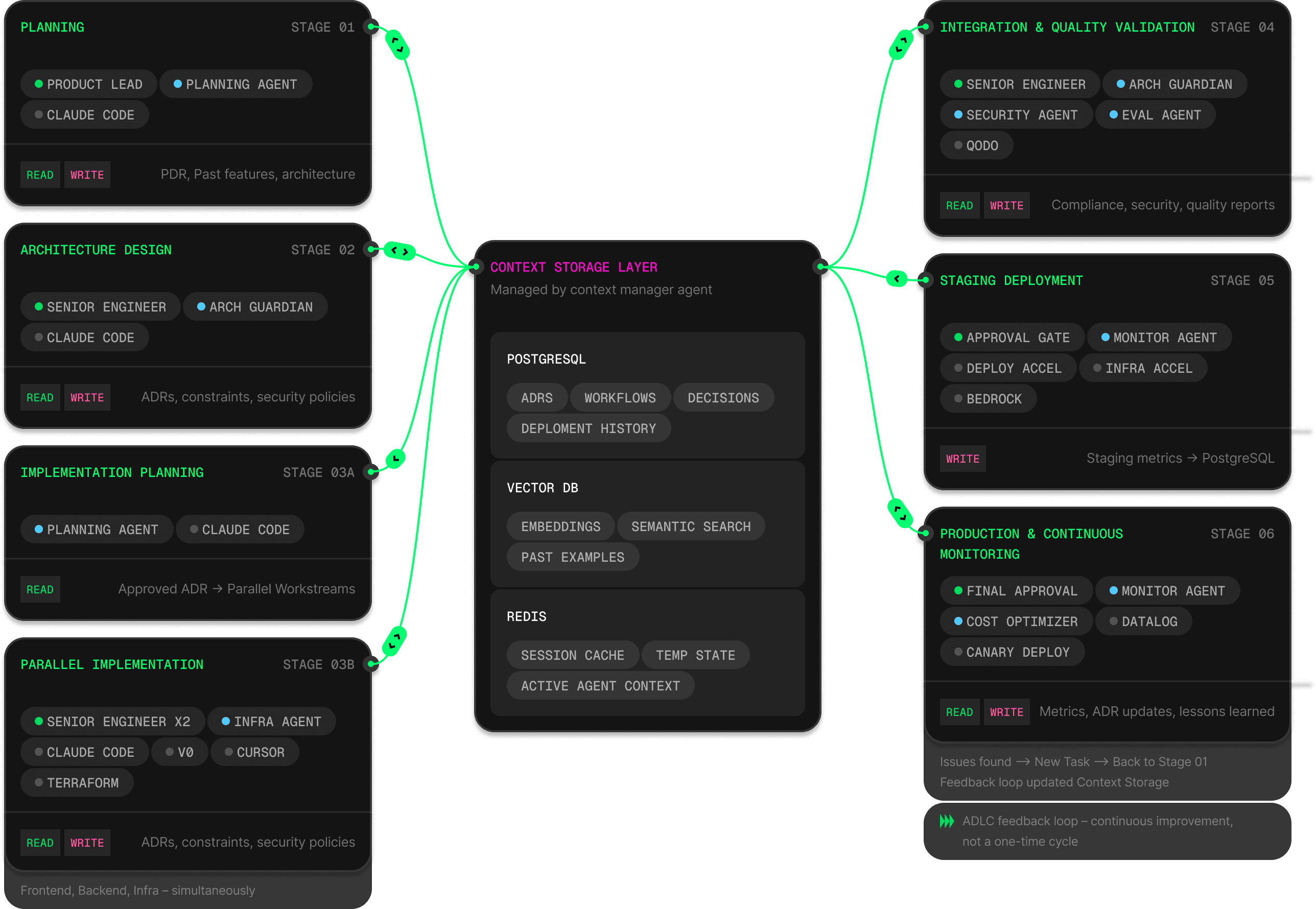
Human Participant
AI Agent
Tool/Accelerator
read
Кead from Context Storage
write
Writes to Context Storage
layer
Context storage (persistent memory)
Ready to ship
3x faster?
Building from zero or transforming existing operations? Time to claim your unfair advantage.